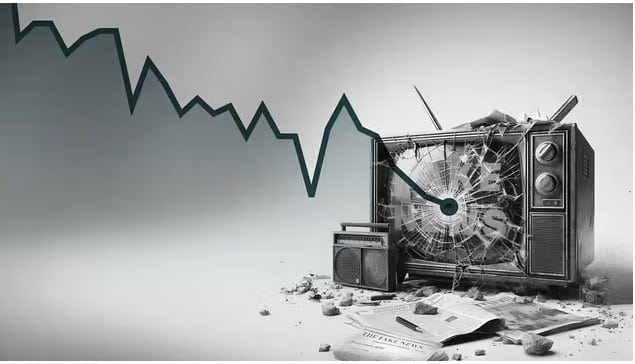
Image Credit: Gallup Poll
There was a time—gather ‘round, kids—when the phrase “according to the news” actually meant something.
People watched.
People trusted.
People nodded along like the anchor was reading from stone tablets handed down from Mount Journalism.
Fast forward to today…
And the public reaction is closer to:
“Yeah… I’m gonna need a second source. And maybe a third.”
The Ratings Are In… and They’re Not Good
Let’s start with the numbers that would make any newsroom quietly turn off the lights and go home early:
- 34% of voters say national news media does a good or excellent job
- 43% say it does a poor job
- The rest are somewhere between “skeptical” and “I only watch for the weather”
That’s not a credibility gap.
That’s a credibility canyon.
Enter Elon Musk, Stage Right
Then along comes Elon Musk, who—never one to waste words—responds to a post about media credibility with a single, elegant, devastating sentence:
“Zero.”
No white paper.
No panel discussion.
No “sources familiar with the matter.”
Just… Zero.
The Public Response: “Yeah, That Sounds About Right”
Here’s where things get awkward for the media class.
- 56% of voters agree that legacy media now has “zero credibility”
- 33% strongly agree
- 27% disagree
- 17% aren’t sure
Let’s pause on that.
A majority of Americans believe the media has no credibility left.
Not “declining.”
Not “imperfect.”
Zero.
That’s not a dip in trust.
That’s a collapse in confidence.
How Did We Get Here?
This didn’t happen overnight.
Trust erodes slowly… and then all at once.
Years of:
- selective framing
- narrative whiplash
- “anonymous sources” who apparently never sleep
- and corrections that show up three news cycles too late
Have created a simple, brutal outcome:
People stopped believing.
The Satirical Reality of “Trusted Sources”
Think about how the modern news cycle works:
- A story breaks
- It spreads instantly
- It dominates headlines
- Then—quietly—it gets revised, corrected, or walked back
And by that point?
The damage is already done.
But don’t worry.
There will be a panel discussion about “restoring trust.”
The 27% Still Holding the Line
Let’s not forget the 27% who still defend legacy media credibility.
These are the last loyalists.
The faithful.
The people who still believe the phrase:
“Sources say…”
Means something more than:
“We’ll confirm this later. Maybe.”
The 17% Who Aren’t Sure
And then there’s the 17% who aren’t sure.
Which might be the most honest group of all.
Because in today’s media environment, confusion isn’t irrational.
It’s almost rational.
The Bigger Problem
This isn’t just about journalism.
It’s about information itself.
When trust in media collapses:
- facts become negotiable
- narratives compete without resolution
- and every story comes with a built-in question mark
That’s not healthy.
For anyone.
The Irony No One Wants to Admit
The same institutions that once positioned themselves as:
- arbiters of truth
- guardians of facts
- defenders of objectivity
…are now viewed by a majority of the public as:
Unreliable.
That’s not just ironic.
That’s historic.
The Bottom Line
The polling tells a story that’s hard to spin:
- More voters rate the media poorly than positively
- A majority agree its credibility is effectively “zero”
- And trust in traditional journalism continues to erode
Which leaves us with one unavoidable conclusion:
The media didn’t just lose the narrative.
It lost the audience’s belief in the narrator.
And once that’s gone…
No headline, no correction, and no panel discussion is going to bring it back.




0 Comments